Colorado bison, past, present and future
It has been said that at one time “the plains were black and appeared to be moving”. This referred to a creature that today almost seems mythical in its history here in North America. I am speaking of our national mammal, the American Bison.
It is theorized that bison arrived in North America via the Bering land bridge during the Pleistocene Era, somewhere between 330,000 and 130,000 years ago. Currently ranked as the largest mammal in North America at up to 6 feet in height, over 10 feet in length and weighing over 2,000 lbs, it is said that the ancestors who crossed the land bridge were far larger.
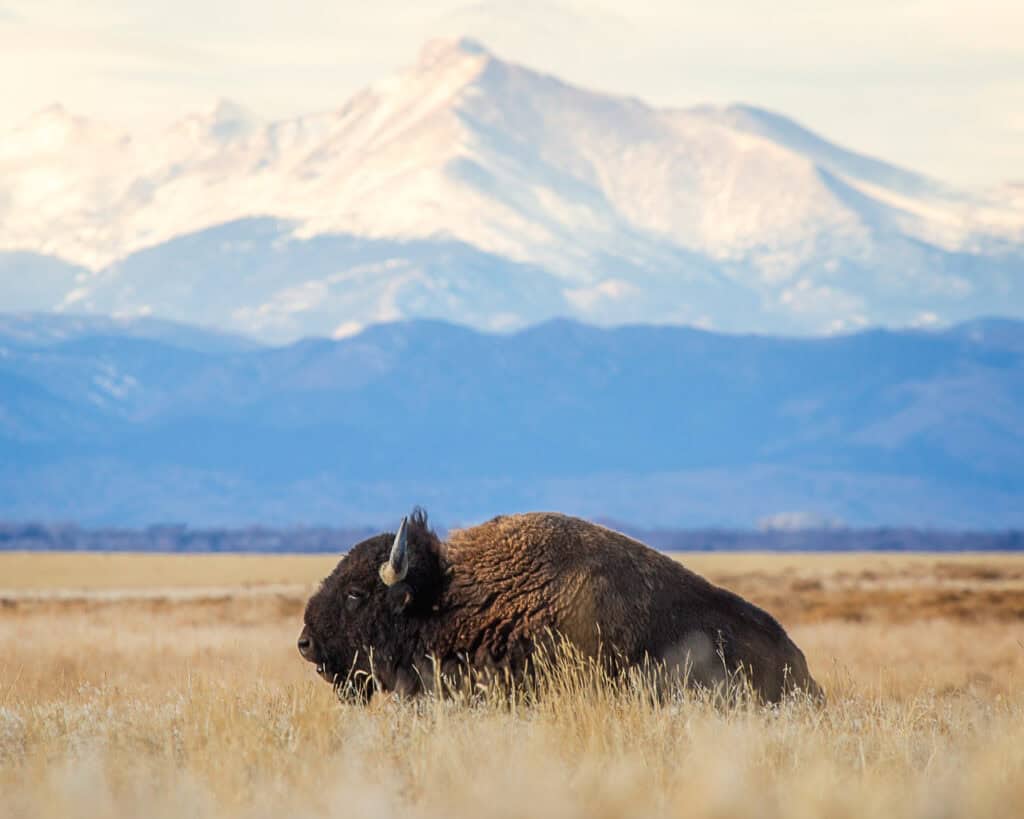
Fossil records show that what we now know as the American Bison first appeared around 5,000 years ago. Their territory prior to European settlement ranged from middle Alaska all the way to the middle of Mexico, and from the Pacific to the Atlantic in numbers estimated between 30-60 million. There are few places they didn’t live, even venturing above timberline in the mountains.
While they had already begun to dwindle prior to the 1800’s, it was the “great western expansion” and the building of the railroads that sealed the fate of these stunning animals. Overhunting and indiscriminate killings brought the wild population to a staggeringly low number of an estimated 1,000. Here in Colorado, there were assumed to be around 20 wild bison in 1889, and by the end of the century there were none.
Currently there are still no truly wild herds native to the state. Occasionally part of the Utah Book Cliffs herd wanders across state lines, but to date, only private livestock and a couple of conservation herds exist. These herds are only “partially wild”, as while they are protected and not harvested, they live in vast enclosures.
On May 9th, 2016 the National Bison Legacy Act was signed into law, designating them as the official national mammal. It is estimated that their numbers are still only around 10,000, with slightly over half being part of the Yellowstone herd. The Hayden and Lamar valleys in the park are the last places where bison have continuously lived since prehistoric times.
In November of 2025, the Colorado Parks and Wildlife Commission unanimously approved regulations regarding guidelines set out by the 2025 Protect Wild Bison Act (SB25-053). As of January 1st, 2026, bison now enjoy dual legal classifications of both livestock as well as wildlife. This provides the wild animals with the same protection afforded to all big game animals in the state.
What this status holds in the way of the return of wild bison to the state remains unclear. The immense changes of land use from the days when wild herds roamed free dramatically limits their potential. The new regulations simply allow for a structure of management for the animals like any big game, were any herds to be brought to the state for re-introduction.
For now, those protections cover those who wander across state lines. Pawnee National Grasslands could be a viable reintroduction area at over 190,000 acres. That said, arranged as a sort of “checkerboard” interspersed with private and other state lands, it is hard to say how a wild population would be handled.
Currently one can visit any of the three conservancy herds in the state. Zapata Ranch in the San Luis Valley as well as the Genessee Park Conservancy allow limited visits and observation opportunities.
Rocky Mountain Arsenal National Wildlife Refuge near DIA offers the best year-round opportunities, with a maintained road passing through the enclosure. However, due to the vast size of the land area, sightings can be hit-or-miss. The most important regulation of the RMANWR enclosure is that you must always remain in your vehicle. As we have learned from far too many not very smart individuals in recent years, it is not a good idea to try to pet the “fluffy cows”.
Originally published in The Mountain-Ear