A glimpse into the winter life of elk
Light snow falls from the sky into the woodland clearing as the day’s remaining sun makes its way through the somber, gray clouds slowly drifting over the peaks above. A frigid breeze gently blows across the treetops, causing the creak of lower trunks and branches rubbing together to create a rhythmic tune. In the distance a lone woodpecker drums its cadence in search of a meal, and the cry of a gray jay makes for a lone lyric in the collective music of nature as it heads back to its nesting shelter for the night.
As this subtle symphony carries through the forest, the sound of a snapping twig breaks the mesmerizing enchantment, then another, and then once more. A slow but steady crunch of snow is discerned, just barely audible through the music. Not the heavy step of a booted foot, but the patient, methodical movement of beings who have intimately known this forest as home for time eternal. One by one, a small band of bull elk enters the snow-blanketed glade and spreads out for a late afternoon meal that will carry them through the long night ahead.
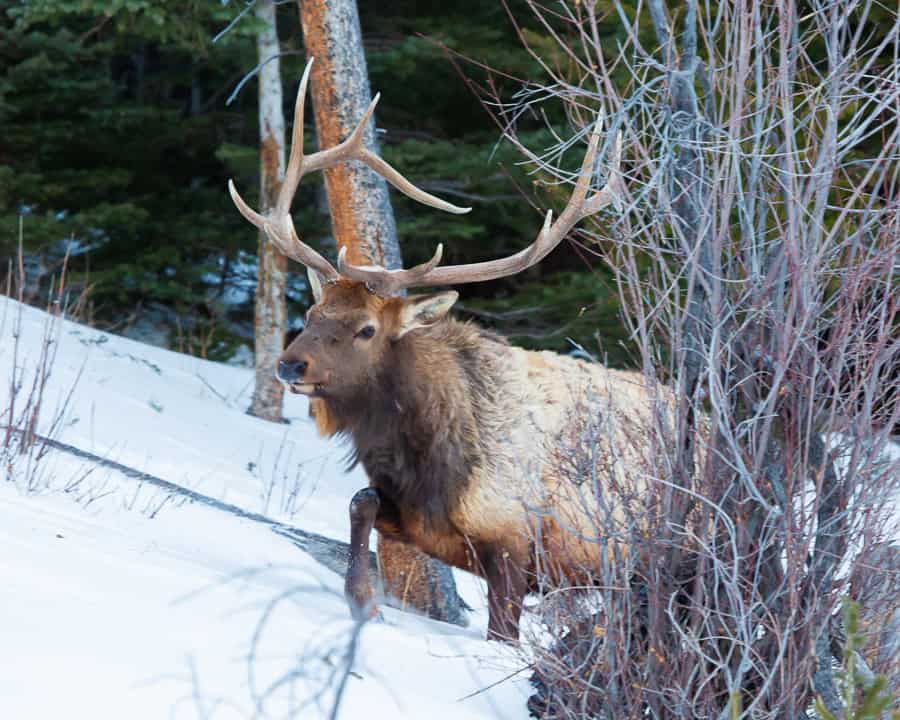
Winter living in the mountains is no easy task, even for a creature seemingly well accustomed to it such as our majestic elk. While herds often tend to migrate to lower elevations for the season, some prefer to keep to the higher country above the foothills. This is more often the case for the small bachelor herds that break off from the main group after the fall rut.
Migrations tend to be spurned by a need for ample food supplies more than a general escape from the harsher climates higher up. If there is ample food available, there isn’t as much of a need to head down the mountain.
When the smaller summer herds of females, babies and yearlings gather for the rut, they tend to remain in that larger group throughout the winter along with the herd bulls. This larger grouping can sometimes hold numbers in the hundreds. With a population of that size, mountain living becomes far less sustainable, ultimately forcing a move that can sometimes take them to the very base of the foothills and the far less snowy grasslands at the edge of the plains.
Bachelor herds typically consist of far lower numbers, usually around a dozen or so, but occasionally gathering as many as 20-30 or more bulls of varying age. I’ve had the pleasure of spending time with some larger groups as they wintered around the ranch pastures on the outskirts of Estes Park. Locally, I have only seen the smaller groupings, and those sightings tend to be rare.
Those that stay don’t tend to wander far in a given day. Survival in the wild is reliant upon conservation of energy. With winter food sources being scarce, long-distance travel would consume far too much of the energy necessary to stay alive.
These herds can often be found near larger mountain meadows in valleys or smaller glades in the higher slopes. If the snow is not too deep, they will use their antlers to dig down to the grass below. While not rich in nutrients like the lush growth of spring and summer, anything helps. When grass is unreachable, they will turn to pine needles and twigs and even bark for sustenance.
The clearings of meadows and glades also provide a source of warmth during the daylight hours, a place to soak in whatever sunlight they may as they graze. If conditions are good enough, they might even enjoy an afternoon bed for an hour or so. If snow is deep, they will remain close to the forest edge, as a trudge too far out into a larger meadow may consume too much energy. They also tend to keep the forest close, retreating to the trees as the cover provides shelter from the oft brutal nightly winter winds.
When I spend time with these beautiful creatures any time of the year, I am always in humble awe at their fortitude, knowing the conditions they endure to live in this mountain kingdom. I am often reminded of a quote about them from one of my favorite naturalist authors, Craig Childs, in his book The Animal Dialogues:
“The elk that you glimpse in the summer, those at the forest edge, are survivors of winter, only the strongest. You see one just before dusk that summer, standing at the perimeter of the meadow so it can step back to the forest and vanish. You can’t help imagining the still, frozen nights behind it, so cold that the slightest motion is monumental. I have found their bodies, half drifted over in snow, no sign of animal attack or injury. Just toppled over one night with ice working into their lungs. You wouldn’t want to stand outside for more than a few minutes in that kind of weather. If you lived through only one of those winters the way this elk has, you would write books about it. You would become a shaman. You would be forever changed. That elk from the winter stands there on the summer evening, watching from beside the forest. It keeps its story to itself.”
Originally published in The Mountain-Ear