A look at some upside-down evolutionary specialization in nuthatches
These little flitters are commonly found in temperate zones throughout the entire northern hemisphere. That said, they possess a very uncommon trait that sets them apart from all other birds in existence. Nuthatches are the only species to have evolved the specialized ability to “walk” upside down as well as face-first down a tree trunk!
If you’re making your way through the forest and you hear a sort-of “light-hearted laugh” coming to you from the trees above, you might want to stop and enjoy a little entertainment. This is one of the calls of the nuthatch easiest to distinguish as they forage. When you do finally see them, they may well be making their way down to you, headfirst.
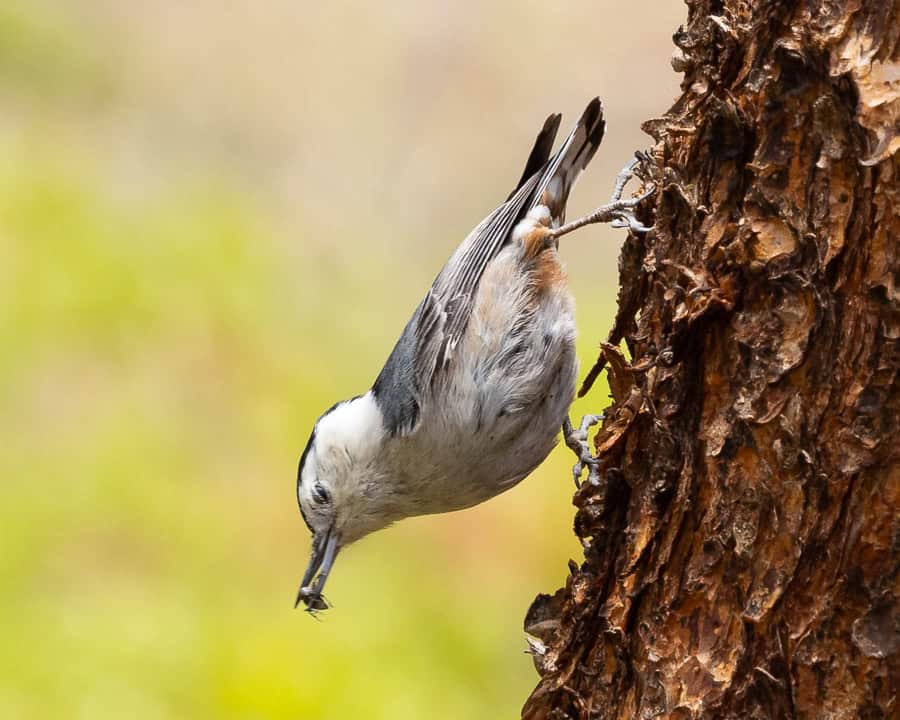
While there are other birds who forage upside down (our mountain chickadees are QUITE adept), they merely do so by hanging from a branch, then letting go and flying to their next spot. Nuthatches on the other hand move fluidly along branches and trunks, both up and down, face-first. This unique ability is made possible by a combination of specialized anatomical traits.
Most birds have evolved to have 4 “toes”, three facing forward and one facing back. The only difference found with 4-toed birds are owls and osprey, who have evolved the ability to shift one of their 3 front toes to the back for better grip of prey. This back-facing 4th toe, sometimes referred to as the “big toe”, is called a hallux.
The configurations and size of the hallux vary from species to species. Water birds have them, but due to more limited use it has evolved to be quite small compared to perching birds. Some land-based species have lost them altogether, lacking the need to grip a perch. Ostriches took the extra step in evolving down to only 2 toes and no hallux.
With nuthatches, the hallux has evolved to be longer and more prominent than the other 3 toes, accompanied by a longer claw. This allows them to maintain a firm grip on the tree bark they are navigating. It provides much better support while performing inverted movement, especially when facing downwards.
Two other specializations are also involved with this talent. Many birds tend to use their long tails braced against a trunk or branch for balance and stability (woodpeckers are a great example). Nuthatches wet the opposite direction and evolved a shorter tail allowing for improved freedom of movement. Other more subtle specializations are a shortened neck and small, rounded body. This allows for a “tucked” and much lower center of gravity necessary for their inverted travel.
Most other birds tend to perform a sort of extended hop when moving from place to place during a tree forage. Nuthatches use their larger hallux to better hold onto their position allowing them to “walk” along the bark, moving each foot independently. The hallux and claw combo provides a strong grip by one foot as the other moves forward while inverted. For a faster descent, they may also hop down face-first, but again, the specialized hallux provides an excellent anchor to stop when needed.
As a former rock climber, this reminds me of what is known as an Australian Rappel (or Aussie Abseil). Rappelling is a common descent technique where one lowers on the rope in large “bounces” down a cliff face. The Aussie style is a high-adrenaline version where one faces towards the ground as opposed to feet first.
While we don’t know for certain why they evolved this unique movement behavior, it is generally thought to allow them the ability to locate bugs in their tree-bark terrain that other birds who hunt the same tree can’t see. Along that line of logic, it also allows them to stash seeds in places other birds may not find later.
If you’re out looking for this behavior, it’s helpful to know that nuthatches are often found foraging with chickadees and juncos. As a team working in different areas of a tree and the surrounding ground, this allows for multiple sets of eyes in different places all looking out for possible danger to the mixed flock. Once found, have a seat and enjoy a spectacular display of acrobatics accompanied by the joyful laughs and titters as they chatter among themselves (possibly about you!).
Originally published in The Mountain-Ear