Understanding the vibrant world of bird plumage
The award for most vibrant in all the animal kingdom falls in the avian category, without question. Birds possess a stunning array of colorful plumage, from the drab camouflage necessary for protection, to stunning, almost gaudy displays. Understanding where this aspect of beauty comes from is an interesting look at how the world is perceived by all animals, not just we humans.

The root of all this color comes from 2 sources, pigmentation and physical feather structure. Pigmentation is broken into 3 separate factors, carotenoids, melanin’s and porphyrins. Specific colors come from either individual traits or interacting combinations of said pigments.
Carotenoids are produced by an animal’s diet. These pigments tend to produce some of the more vibrant colors. A great example of these is found in pink flamingoes. These birds gain their distinct hue from a diet of brine shrimp and blue-green algae.
Melanin’s are tiny granular structures found in both skin and feathers. They tend to produce a range of colors from the dark and ruddy to more pale lighter colors. Beyond coloration, melanin also improves a feather’s strength and durability. A white feather is far more susceptible to damage than one containing melanins and thus darker in color.
Porphyrins are produced by amino acids. These pigments share a common trait in that they all fluoresce a bright red when exposed to ultraviolet light. This is an important factor among birds, as one of the color receptors they possess that we humans don’t are specifically devoted to these wavelengths of light.
It is important to note that not all birds possess all three pigments. While nearly all birds produce melanin’s; carotenoids and porphyrins are typically developed based on diet and specific evolutionary development.
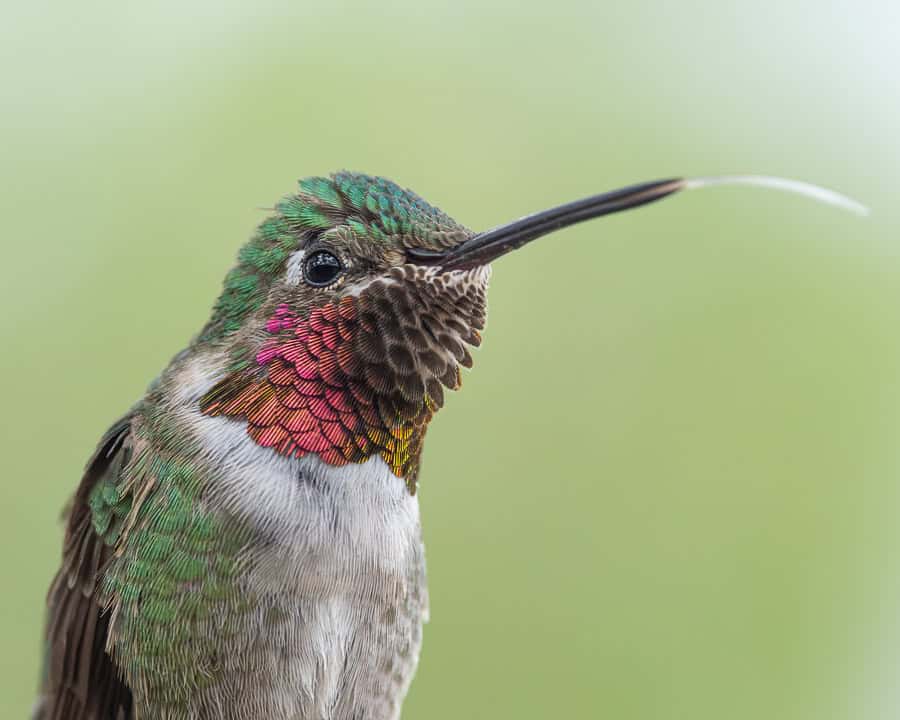
Feather structure itself is also a determining factor in the perceived colors. The colors are dictated by how light is refracted off proteins in the feather itself. Iridescence, as seen in the shiny gorgets (neck feathers) of hummingbirds, is caused by miniscule feather barbules that act as a sort of prism. They refract light in different ways depending on the angle being viewed.
In the photo example of the male broad-tailed hummingbird, we are seeing the shiny refraction creating a mix of reds and magentas. When viewed in a flatter light, this same gorget will appear a duller, ruddy red. Rufous hummingbirds are even more distinctly brilliant, flashing a brilliant gleaming gold in the right light. When battling over territory, humminbirds will flare their gorgets, likely to increase the iridescence as a form of dominance or intimidation.
It is very important to note that the perception of these colors varies greatly in the animal kingdom. Most mammals have only two color receptors in their eyes. Higher primates possess three. Reptiles and amphibians possess up to four, and most birds possess five. Insects vary from none at all to a stunning fifteen. This perception of color and light plays a huge role in how different creatures navigate life and survival.
Sexually, it seems that monogamous birds, like many raptors, tend to display similar color patterns between males and females. Polygamous birds often vary greatly between sexes. Females lean towards a duller color pattern, and males tend to be significantly more flamboyant. As with most animals, it is ultimately the female who chooses whom she mates with, and the males utilize their more brilliant plumage (sometimes quite grandly) in hopes of attracting a mate.
They say that beauty is in the eye of the beholder. The next time you’re out observing these winged creatures, know that while they may also be appreciating their own beauty, in some cases that beauty translates to something far more important than mere aesthetics. There is FAR more to it than meets our mere human eyes!
Sources:
https://academy.allaboutbirds.org/how-birds-make-colorful-feathers/
https://web.colby.edu/mainebirds/2023/10/27/color-vision-in-birds/
Originally published in The Mountain-Ear